
Navigating the WHOIS Landscape: Understanding Domain Ownership, Privacy, and Beyond
The internet, a vast digital expanse, is built upon a foundation of interconnected websites and services, each identified by a unique domain name. But these aren’t just random strings of characters; behind each domain lies a real-world entity – an individual, a business, an organisation – responsible for its existence. In today’s digital age, where trust and transparency are paramount, understanding domain ownership and privacy is crucial. Enter the WHOIS database, a powerful tool that sheds light on the identities behind the online facade. This article delves into the world of WHOIS, exploring its origins, purpose, limitations, and the ever-evolving realm of domain privacy.Unveiling WHOIS: A Digital Registry
The WHOIS database functions as a digital repository, meticulously housing the registration details of every domain name. Its roots can be traced back to the ARPANET, the internet’s predecessor, where it served as a directory for users. Today, under the watchful eye of the Internet Corporation for Assigned Names and Numbers (ICANN) since 1982, WHOIS has become a cornerstone of internet governance. This system acts as a beacon of transparency and accountability, acting as a public record for domain ownership. WHOIS fulfills a critical role by revealing vital information such as: The registrant’s name Address Contact number Email address Statistics: ICANN manages over 1.5 billion domain name registrations globally.A Beacon of Transparency
In the early days of the internet, when ARPANET facilitated the exchange of data, WHOIS emerged as a necessity. It provided a way to track the flow of information across the network. As the internet ballooned in size and complexity, so did the role of WHOIS. Today, in a digital landscape plagued by misinformation and online fraud, WHOIS serves as a crucial weapon in the fight against falsehoods and in ensuring the integrity of online content. By empowering users to trace the origins of websites and online services, WHOIS fosters a safer and more trustworthy online environment by promoting transparency and accountability.Information Stored and Privacy Options: Balancing Transparency with Security
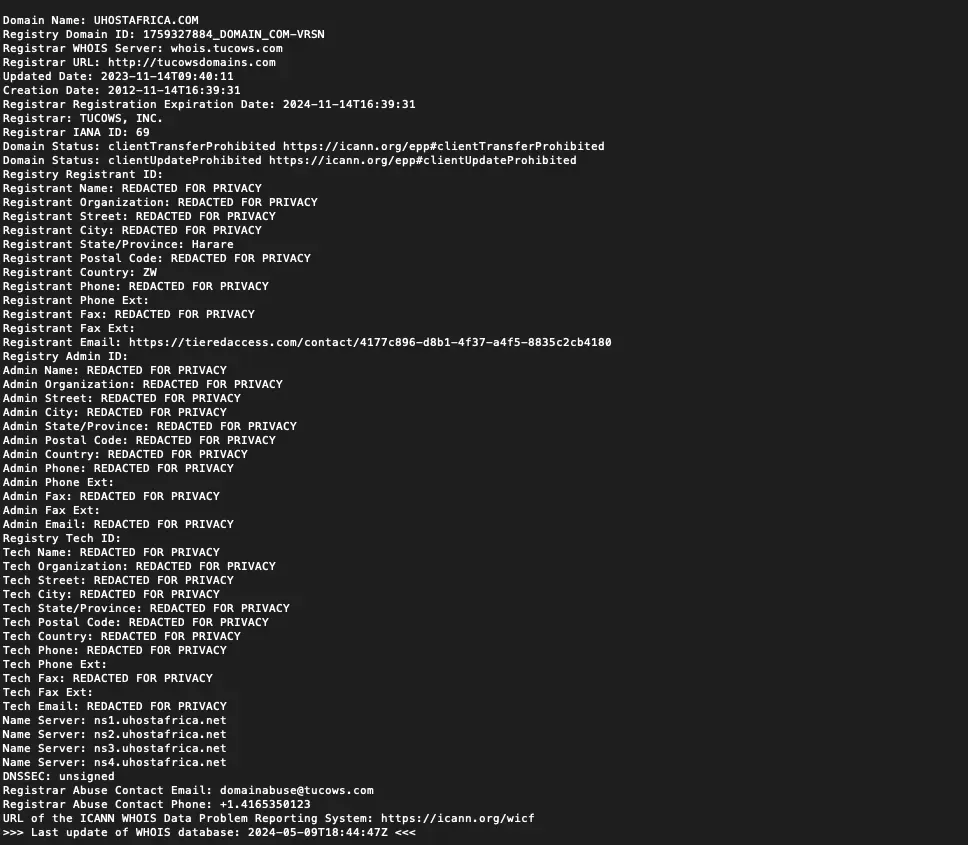
When registering a domain name, individuals are required to provide accurate information, including their name, address, phone number, and email address. Failure to do so can result in the domain being suspended or even canceled. However, in an era where online privacy is a growing concern, domain privacy options offer a shield against unwanted exposure of personal details. Registrars often provide domain privacy services, substituting their own contact details for those of the domain owner. This acts as a buffer, safeguarding personal information from public scrutiny. At uHostAfrica we provide privacy service as an add on when you purchase your domain.